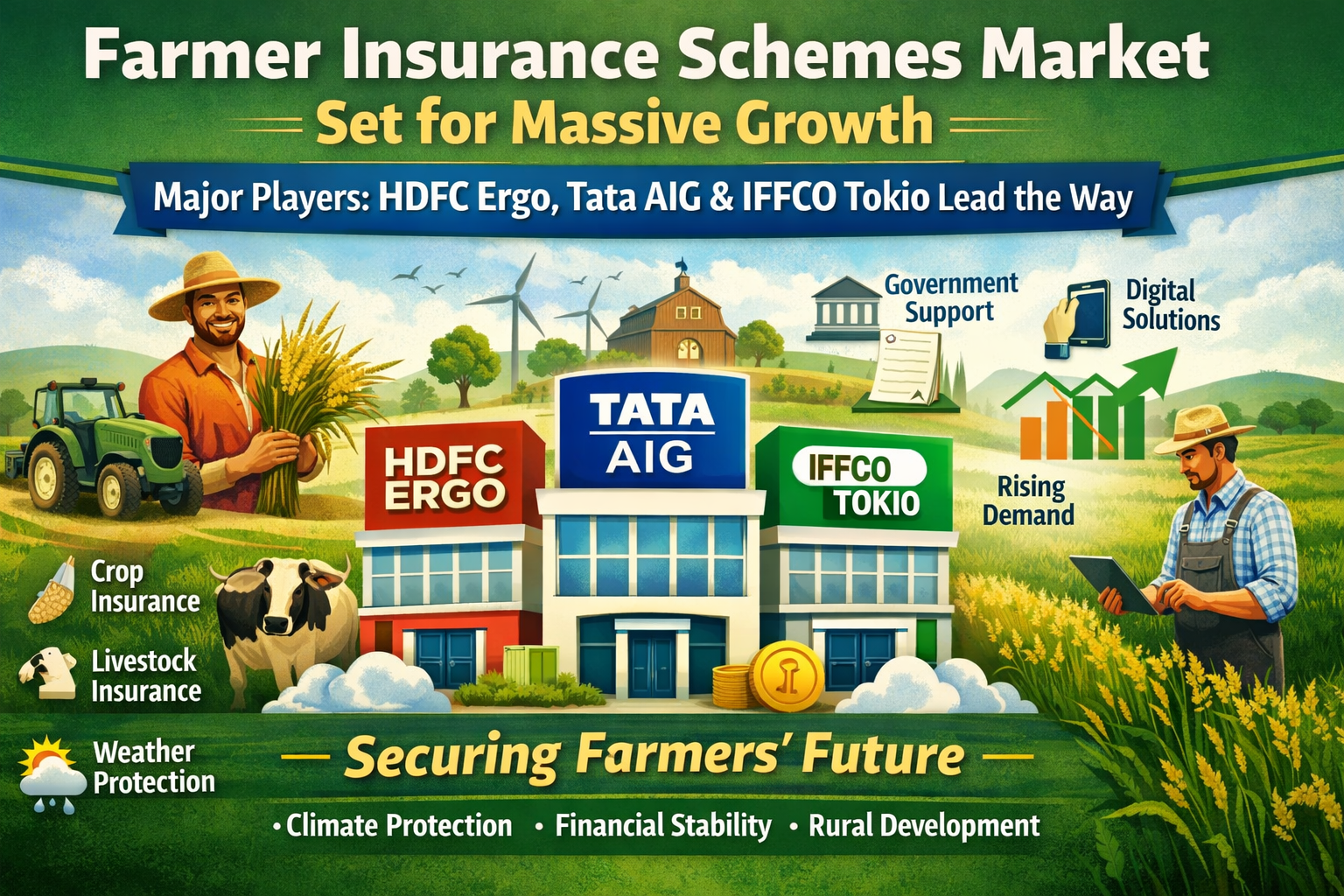
Farmer Insurance Schemes Market: India’s agriculture sector is undergoing a major transformation, and farmer insurance schemes are becoming an essential safety net for millions of cultivators. With unpredictable weather, rising input costs, and increasing financial risks in farming, insurance coverage is now considered a critical tool to protect farmers’ livelihoods. As awareness grows and government initiatives continue to expand, the farmer insurance market in India is expected to witness significant growth in the coming years.
Several leading insurance providers are actively strengthening their presence in this segment. Major companies such as HDFC Ergo, Tata AIG, and IFFCO Tokio are expanding their farmer-focused insurance offerings with innovative products and digital claim systems. These insurers are working closely with government schemes, financial institutions, and agri-tech platforms to make crop and farm insurance more accessible to rural communities.
Highlights of the Farmer Insurance Market
| Key Aspect | Details |
|---|---|
| Market Focus | Insurance coverage for farmers and agricultural assets |
| Major Companies | HDFC Ergo, Tata AIG, IFFCO Tokio |
| Growth Drivers | Climate risks, government schemes, digital insurance platforms |
| Target Beneficiaries | Small and marginal farmers across India |
| Key Insurance Types | Crop insurance, livestock insurance, weather insurance |
| Market Outlook | Strong growth expected in the coming years |
Growing Importance of Farmer Insurance in India
Agriculture remains one of the most important sectors of the Indian economy. However, farmers face multiple uncertainties, including unpredictable rainfall, floods, droughts, pest attacks, and market fluctuations. These risks often lead to heavy financial losses for farmers.
Insurance schemes designed specifically for farmers help mitigate these risks. By paying a small premium, farmers can secure financial compensation if their crops fail due to natural disasters or other covered risks.
In recent years, government initiatives and private sector participation have helped expand insurance coverage in rural areas. Programs aimed at increasing awareness and simplifying the claim process are also encouraging more farmers to adopt insurance policies.
Role of Major Insurance Companies
Private insurance companies have played a significant role in expanding farmer insurance coverage across the country. Leading firms are introducing customized policies that cater specifically to the needs of farmers.
Also read: Blackstone Eyes Entry Into India’s General Insurance Market With Possible Venture Led by Anuj Tyagi
HDFC Ergo
HDFC Ergo is one of the prominent insurers involved in agricultural insurance programs. The company offers several insurance products designed to protect farmers from crop losses and other agricultural risks. Its digital platforms help simplify enrollment, premium payments, and claim settlements.
The company also works with government-backed crop insurance schemes, ensuring that farmers receive financial support quickly during difficult seasons.
Tata AIG
Tata AIG has developed multiple agricultural insurance solutions that aim to provide protection against natural disasters, pest infestations, and other crop-related damages. The company is focusing on improving insurance penetration in rural areas through technology-driven services.
Mobile-based policy enrollment and faster claim settlement processes have helped Tata AIG build trust among farmers in many states.
IFFCO Tokio
IFFCO Tokio is another major player in the farmer insurance market. The company has a strong rural presence and works closely with farmer cooperatives and agricultural organizations.
It offers various insurance products for crops, livestock, and farm equipment. Through its network of rural service centers and digital tools, IFFCO Tokio is helping farmers access insurance coverage more easily.
Types of Insurance Schemes Available for Farmers
Farmer insurance schemes cover different aspects of agricultural activities. These policies are designed to protect farmers from financial losses caused by natural disasters or other unexpected events.
Crop Insurance
Crop insurance is the most widely used form of agricultural insurance. It protects farmers from losses due to drought, floods, cyclones, pest attacks, and disease outbreaks.
Under these policies, farmers receive compensation if their crop yield falls below a predetermined threshold due to covered risks.
Livestock Insurance
Livestock insurance protects farmers against the loss of animals such as cattle, goats, sheep, and poultry. Since livestock plays a crucial role in rural income, insurance coverage ensures farmers can recover financially if animals die due to accidents or diseases.
Weather-Based Insurance
Weather-based insurance policies provide financial compensation when certain weather conditions exceed or fall below predefined levels. For example, farmers may receive compensation if rainfall is significantly lower than expected during the growing season.
This type of insurance reduces the complexity of crop damage assessment because payouts are based on weather data rather than field inspections.
Farm Equipment Insurance
Many farmers invest heavily in tractors, irrigation pumps, harvesters, and other agricultural equipment. Insurance coverage helps protect these assets against theft, accidents, or damage caused by natural disasters.

Government Support for Farmer Insurance
The growth of the farmer insurance market is closely linked to government initiatives. Several schemes aim to increase insurance coverage among farmers and reduce the financial burden caused by crop failures.
Government-backed programs often provide premium subsidies, making insurance policies affordable for small and marginal farmers.
In many cases, the government also collaborates with private insurers to implement crop insurance schemes across different states. This public-private partnership approach has helped expand insurance coverage to millions of farmers.
Technology Transforming Agricultural Insurance
Technology is playing a major role in transforming the agricultural insurance industry. Insurance companies are now using advanced tools such as satellite imagery, remote sensing, and artificial intelligence to assess crop conditions and verify claims.
Digital platforms also allow farmers to purchase policies, submit claims, and track application status through mobile applications. This has significantly reduced paperwork and improved transparency in the insurance process.
Additionally, agri-tech startups are partnering with insurance companies to provide data-driven solutions that improve risk assessment and policy pricing.
Benefits of Farmer Insurance Schemes
Farmer insurance schemes provide several advantages for both farmers and the agricultural sector as a whole.
One of the most important benefits is financial stability. Insurance payouts help farmers recover quickly from crop losses and continue their farming activities.
Insurance coverage also encourages farmers to adopt modern agricultural practices. When farmers feel financially protected, they are more willing to invest in better seeds, fertilizers, irrigation systems, and machinery.
Furthermore, farmer insurance contributes to overall rural economic stability by reducing the financial impact of agricultural disasters.
Challenges in the Farmer Insurance Market
Despite its growth potential, the farmer insurance market still faces several challenges.
Many farmers remain unaware of available insurance schemes or lack adequate information about policy benefits. Limited financial literacy in rural areas can also make it difficult for farmers to understand insurance terms and conditions.
Another challenge is the delay in claim settlements, which can discourage farmers from purchasing insurance policies. However, the introduction of digital technologies and automated claim systems is gradually improving this situation.
Insurance companies are also working on simplifying policy documents and improving customer support services to address these issues.
Future Outlook for the Farmer Insurance Industry
The future of farmer insurance in India looks highly promising. As climate risks continue to increase, the demand for agricultural insurance is expected to grow rapidly.
Insurance companies are likely to introduce more customized policies tailored to specific crops, regions, and farming practices. These specialized products can provide better protection and encourage wider adoption among farmers.
Government initiatives aimed at expanding crop insurance coverage will also play a major role in boosting market growth. Increased collaboration between insurers, banks, agri-tech companies, and government agencies will further strengthen the farmer insurance ecosystem.
With the combined efforts of public and private stakeholders, the farmer insurance market is expected to become a key pillar of India’s agricultural risk management strategy.
Important Links
| Resource | Link |
|---|---|
| Farmer Insurance Information Portal | https://www.india.gov.in |
| Agricultural Insurance Guidelines | https://agricoop.nic.in |
| Insurance Regulatory Authority | https://www.irdai.gov.in |
| Crop Insurance Scheme Details | https://pmfby.gov.in |
FAQ Farmer Insurance Market
What is farmer insurance?
Farmer insurance is a type of insurance policy designed to protect farmers from financial losses caused by crop failures, livestock deaths, natural disasters, and other agricultural risks.
Which companies provide farmer insurance in India?
Several insurance companies offer farmer insurance products, including HDFC Ergo, Tata AIG, and IFFCO Tokio, along with other public and private insurers.
Why is crop insurance important for farmers?
Crop insurance provides financial protection against losses caused by droughts, floods, pest attacks, and other natural disasters, helping farmers maintain economic stability.
How can farmers apply for agricultural insurance?
Farmers can apply for insurance through banks, insurance agents, government schemes, or online platforms offered by insurance companies and agricultural departments.